CEF Home For Industry For Educators For Students

Fats, such as palm oil or lard, are used to make bars of soap.

You Be The Chemist ChallengeYou Be The Chemist Challenge

The You Be The Chemist (YBTC) Challenge is a fun and innovative academic competition that engages 5th-8th grade students in the science of chemistry. The Challenge:

  • educates students about the science of chemistry as it applies to their everyday lives
  • provides educators with an exciting way to educate their students about science
  • encourages parents to participate in their child's education
  • provides industry members a tool to help develop a stronger relationship with their community

The Challenge brings students, educators/administrators, parents, industry members, and other community members together to celebrate the science of chemistry!
 

The 2010 National Challenge will be held on June 18 at the National Constitution Center in Philadelphia, PA. Join us for a celebration of chemistry! (Click the link to visit the National Challenge page and register for this exciting event.)

YBTC Challenge Structure

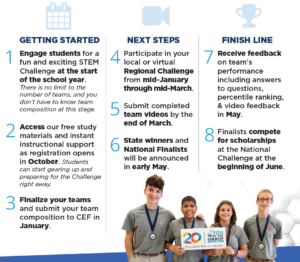
The YBTC Challenge is organized into three competitive levels - local, state, and national. Local Challenge sites are established across the country through the collaborative efforts of industry members, educators, and other community members. The winning students from those competitions advance to a state competition, with state winners advancing to the National Challenge organized by CEF. Local and state competitions take place throughout the year, and the cycle ends with the national competition in June.

For more information about each level of the Challenge and to learn how YOU can get involved, follow the links below:

  • Local YBTC Challenges - the 2009-2010 registration deadline has passed; start getting organized today and submit your registration early for the 2010-2011 Challenge cycle (registration forms will be available in September)
  • State YBTC Challenges
  • National YBTC Challenge - June 18, 2010 at the National Constitution Center in Philadelphia, PA


Get involved with the You Be The Chemist Challenge today!

Visit the Local Challenges page to browse a list of active Challenge sites across the country and learn how you can champion a Local Challenge site in your community.

To download the current Challenge Study Guide, visit the Study Materials page of the students section.
 

For assistance or more details, please contact us at challenge@chemed.org.

 

YBTC Challenge Rules (2009-2010):

A Local Challenge site is a location where a Local Challenge is established with CEF’s consent. All Local Challenge sites must comply with the rules set forth in the You Be The Chemist Challenge 2009-2010 Guidelines in order to register as an official Local Challenge site. A portion of the rules contained within that document are detailed below:

Each registered Local Challenge site must designate an individual to serve as the site’s Local Challenge Organizer. The Local Challenge Organizer (Organizer) will utlize CEF’s materials to coordinate all aspects of their site’s Local Challenge, which shall include such responsibilities as providing the required information about their site to CEF, disseminating the appropriate information to participating students and educators, establishing a competition format for their site, and seeking industry sponsorships.

All sites must complete the Local Challenge Registration, located on CEF’s Web site at  www.chemed.org/ybtc/challenge/local.aspx and submit it to CEF in order to be considered as an official Local Challenge site. In addition, all Local Challenge sites must meet the following requirements:*

  • In order to register a Local Challenge site, Organizers should ensure the participation of at least 40 students (1-2 classrooms).
  • Local Challenge sites should be organized according to county boundaries with the exception of the 20 largest U.S. cities (New York, Los Angeles, Chicago, etc.), which should be established as independent Local Challenge sites.

* Local Challenge sites established during previous Challenge cycles that do not meet the above requirements should contact CEF to seek approval to operate under their established site structure.

All educators involved in organizing Local Challenges and all potential participants MUST be notified of the following rules and requirements before being able to register for the Challenge. Participants must satisfy all of the following requirements:

  • Participation in Challenge competitions is open to all 5-8th grade students regardless of race, religion, creed, gender, or type of school one attends. Participation should NOT be contingent upon any other requirements such as membership in an organization, club, or other scholastic activity.
  • Participants must not have passed beyond the eighth grade on or before April 1, 2010.
  • Participants must not reach the age of 15 on or before September 1, 2010.
  • Participants must enter State and National Challenge competitions in the same academic year in which they qualified from their Local Challenge competition.
  • Once a participant has won the National Challenge, that participant is ineligible for future participation in the Challenge.

CEF provides the Challenge curriculum for each level of the Challenge in the form of a Study Guide. The official source for all answers to questions developed for Challenge competitions will be found in the Study Guide material as posted on the CEF Web site at www.chemed.org. CEF recommends that Organizers notify participants as soon as the Study Guide is posted on the CEF Web site, so they may have ample time to prepare for the Challenge and further their knowledge and understanding of chemistry.


Only Study Guides from the current academic year (2009-2010) should be made available to participants. Organizers should not distribute Study Guide materials from previous academic years as the 2009-2010 Challenge Study Guide material is different from previous years.
Organizers must inform participating educators and students of the following:

  • Challenge Study Guide material can be found on the Study Materials section of CEF’s Web site at www.chemed.org/ybtc/students/study.aspx.
  • Challenge competition questions are based on an understanding of the Study Guide material, often requiring students to apply the information to both familiar and unfamiliar situations.
  • For Local Challenge competitions, participants will need to study the Study Guide material labeled as “Basic.” For State Challenge competitions, they will need to also study the material labeled as “Intermediate.” For the National Challenge, participants will need to also study the material labeled as “Advanced.”

CEF will provide all competition questions and answers to the Organizers for use in their competitions. Participants must compete ONLY with the questions supplied by CEF for that level of the competition and for that Challenge cycle. (A Challenge cycle will begin with each school year and end with the National Challenge in June.) No other questions should be used during the competition. Study materials and questions will vary based on the level of competition and from cycle to cycle.

Challenge competition questions are the intellectual property of CEF and are to be used for competitions ONLY. Questions, multiple-choice answers, and correct answers are NOT to be distributed to participants at any time, as it could result in disqualification of individual participants or an entire site. Any other use of the Challenge questions, multiple choice answers, and correct answers are not authorized and is strictly prohibited.

Only answers contained in the curriculum supplied to the Organizers by CEF should be accepted as correct, unless determined otherwise by the competition judges’ majority decision.

See the You Be The Chemist Challenge 2009-2010 Guidelines for the complete rules.


Study Materials

The complete 2009-2010 Study Guide and all divisions have been posted on the Study Materials page of the Students section of the Web site. The Study Guide is provided to help students succeed at every level of the Challenge. The Study Guide is divided into three categories – basic, intermediate, and advanced (posted as separate documents), which correspond to the three levels of the Challenge – local, state, and national.